
Amazon FBA Prep Requirements: The Complete Guide for Sellers
By the Coastline Fulfillment team · · 10 min read
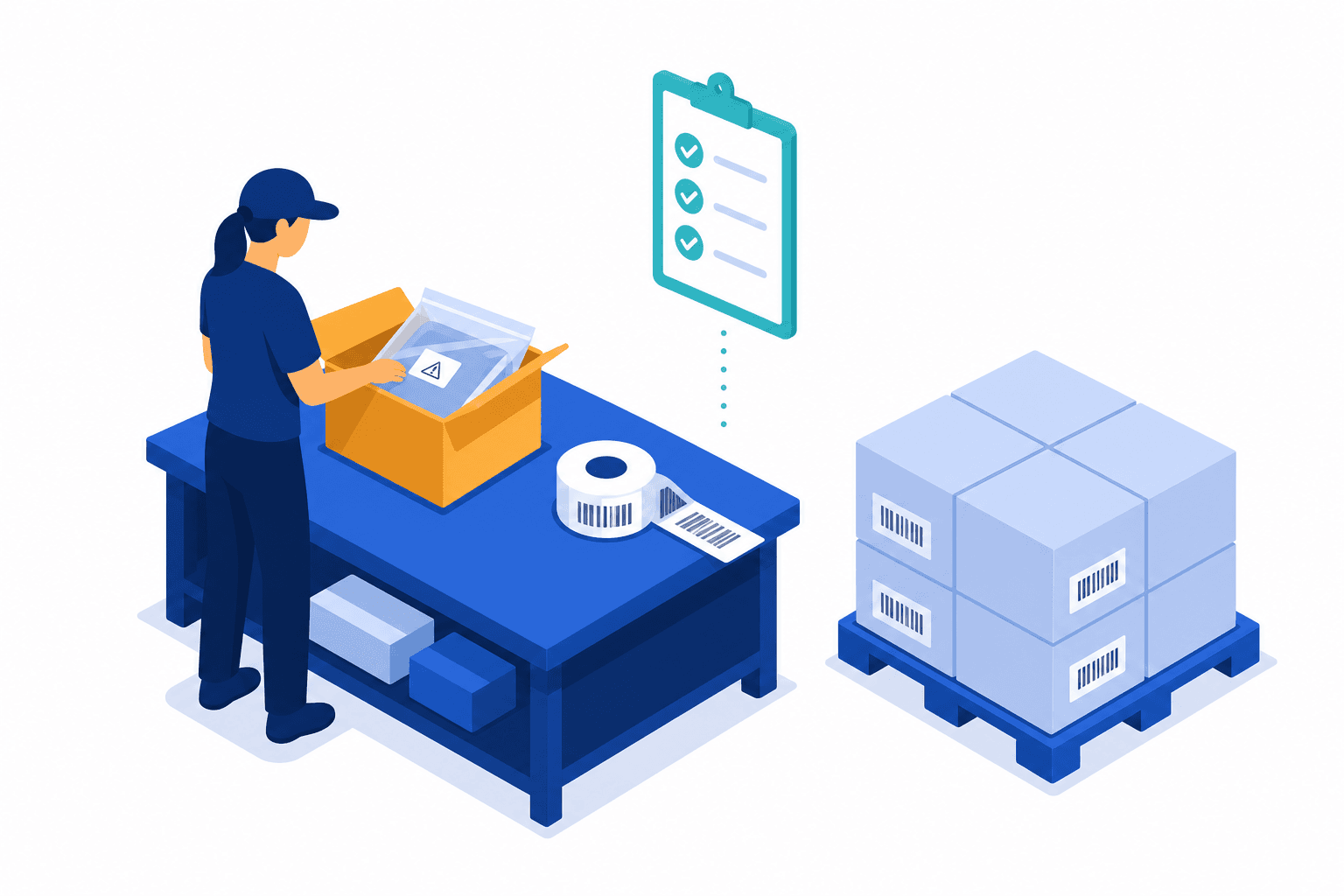
Most FBA horror stories start the same way: a shipment checks in late, “unplanned prep” fees appear, or a batch of units strands — and the seller learns a poly bag was too thin or a barcode wouldn’t scan. Nearly all of it traces back to Amazon FBA prep requirements: the packaging and labeling rules that decide whether your inventory glides through receiving or gets stuck in it.
This guide covers what the rules actually are, where sellers get burned, and how to decide whether to keep prepping in-house — written by people who prep FBA inventory every day.
What “FBA prep” actually means
FBA prep is everything that happens to a unit between your supplier and Amazon’s inbound dock: poly bagging, bubble wrapping, bundling, taping, applying FNSKU labels, adding expiration dates. The goal is simple — each unit has to survive Amazon’s fulfillment network and arrive at a customer’s door in new condition, identifiable by exactly one scannable barcode.
Amazon requires prep because its fulfillment centers are built for speed, not care. Your product rides conveyors, drops into totes, and gets picked by associates and robots handling thousands of items per shift. If powder can leak, glass can shatter, or fabric can pick up warehouse grime along the way, Amazon expects you to have prevented it before the carton was ever sealed.
When inventory arrives out of spec, a few things can happen — none of them good. Amazon may prep or relabel it for you and charge a per-unit unplanned service fee. The shipment can be routed into problem receiving, which delays check-in by days or weeks. Units can sit stranded and unsellable while you open cases. In worse scenarios, Amazon refuses the shipment or disposes of the inventory, and repeated problems can restrict your ability to send more.
Amazon’s packaging requirements
Every one of Amazon’s FBA packaging requirements answers the same question: could this unit take rough handling and still reach a customer looking new — without damaging anything around it?
Poly bagging: thickness, suffocation warnings, and when it’s required
Poly bags are required whenever the product or its packaging leaves something exposed: apparel and textiles, plush toys, anything sold without a box, boxes with open windows or hanging holes, powders and granular products, and small items that could slip out of a tote.
The bag itself has to meet spec:
- At least 1.5 mil thick and fully transparent
- Completely sealed — self-seal adhesive, heat seal, or taped shut
- A barcode that scans through the bag, or an FNSKU label applied to the outside
- No more than 3 inches of excess bag beyond the product
- A suffocation warning on any bag with an opening of 5 inches or larger, measured flat
Bubble wrap, boxing, and taping: fragile items, liquids, and sold-as-set
Fragile and glass items must be fully encased in bubble wrap or boxed with enough cushioning that nothing shifts. Amazon’s benchmark is surviving a drop of about three feet onto a hard surface, on any face or corner. Our shorthand: wrap it, tape the wrap so it can’t unravel, then shake it — if you can hear the product, start over. The barcode goes on the outside of the wrap.
Liquids need to be sealed against leaks: double-sealed caps, or a sealed poly bag as a second layer. One leaking unit can contaminate an entire tote of inventory, and Amazon knows it.
Products sold together must stay together. Multi-packs and bundles get physically unified — bagged, shrink-wrapped, or banded — and labeled “Sold as set” or “This is a set. Do not separate.” Only the set’s barcode should be visible. Cover every component barcode, or someone at the fulfillment center will cheerfully scan and sell your four-pack one unit at a time.
For the boxes themselves: sturdy six-sided cartons, quality shipping tape, and no lashing multiple case packs together to make one “box.”
Labeling requirements: FNSKU, expiration dates, and more
Every unit entering an Amazon fulfillment center needs exactly one scannable barcode. Which barcode depends on your situation.
FNSKU vs. manufacturer barcode. The FNSKU (it starts with X00) is Amazon’s own identifier — it ties each physical unit to your specific listing and your seller account. A manufacturer barcode is the UPC or EAN already printed on the product’s packaging.
The rules here changed in 2026. Amazon ended commingled inventory, and barcode requirements now follow your selling role: resellers must label with FNSKUs, even when the product carries a perfectly good UPC, while brand owners enrolled in Brand Registry as the brand representative can ship eligible products “stickerless” under the manufacturer barcode. Eligibility is per ASIN — check it in Seller Central rather than assuming, and when in doubt, the FNSKU is always the safe answer.
FNSKU labeling and placement is where careful prep shows:
- Print with a thermal or laser printer — inkjet smears and fails scans
- Apply to a flat surface, never over a curve, corner, or seam
- Don’t cover the label with tape or bury it under shrink wrap
- Cover any other scannable barcode with an opaque label so only one survives
- Scan-test units before the carton closes (we scan-check every label we apply)
Expiration date labeling for FBA applies to anything consumed or applied to the body — food, supplements, topicals, many pet products — plus anything with a date already printed on it. The rules:
- Dates must be in MM-DD-YYYY or MM-YYYY format (a spelled-out month abbreviation, like 15-JAN-2027, is also accepted)
- The date goes on each unit and on the master carton, in 36-point or larger type on the carton
- Lot codes don’t count, and manufacture dates must be covered — either can get your units received as expired
- If the printed date is in the wrong format, cover it with a label in the correct format
- Don’t mix expiration dates within the same box
- Units must arrive with enough remaining shelf life under Amazon’s current policy; short-dated stock gets refused or disposed of
Category-specific prep rules
Some categories layer extra rules on top of everything above. The short version:
- Grocery and topicals: Expiration labeling as described, sealed leak-proof packaging, and a hard seasonal window for meltables — Amazon only accepts heat-sensitive products like chocolate during the cooler months and disposes of whatever remains in its warehouses when the window closes.
- Baby products: The highest scrutiny in the building. Suffocation warnings are strictly enforced, packaging must fully contain small parts, and anything that looks unsanitary gets flagged fast.
- Sharp items: Blades and points must be secured — sheathed, blister-packed, or wrapped and boxed — so they can’t cut through the packaging or the person handling it. A retail sleeve alone usually isn’t enough.
- Small products: Units around credit-card size or smaller on their longest side must be bagged, with the barcode scannable from outside, so they don’t vanish into the bottom of a tote.
- Apparel and textiles: Everything fabric gets poly bagged to stay clean and dry. Fold it, remove the hangers, and size the suffocation warning to the bag.
The most common prep mistakes (and what they cost you)
These are the failures we see most often on inbound inventory, and what each one actually costs.
- Unscannable or missing FNSKU labels. Smeared inkjet prints, labels over seams, labels under tape. The cost: per-unit unplanned prep fees plus days of receiving delay while Amazon relabels — or a stranded shipment if it can’t.
- Leaving the original barcode exposed next to the FNSKU. Amazon scans whichever barcode it sees first. The cost: units received against the wrong listing, reconciliation cases, and wrong-item orders that come back as returns.
- Poly bag violations. Too thin, unsealed, or missing the suffocation warning. The cost: unplanned bagging fees at best — and because the warning is a safety requirement, repeated misses invite harder enforcement.
- Expiration date problems. Wrong format, a lot code standing in for a date, or a visible manufacture date. The cost: units received as expired and marked unsellable, which usually means removal or disposal while your listing sits out of stock.
- Under-protecting fragile items and liquids. The cost: damaged units are unsellable, one leak can ruin surrounding inventory, and a run of damage complaints from customers can suppress the listing itself.
- Skipping sold-as-set labeling on bundles. The cost: Amazon sells your components individually. The customer who ordered a four-pack receives one unit, returns it annoyed, and the rest of the inventory strands.
- Shipping meltables or short-dated stock at the wrong time. The cost: refusal at receiving, or disposal of whatever Amazon won’t accept — you pay for the goods, the freight, and the destruction.
DIY prep vs. using a prep center
We run a prep center, so you’d expect us to say DIY is a trap. It isn’t. Plenty of sellers should be prepping their own inventory — the honest answer is arithmetic.
DIY genuinely makes sense when:
- Volume is low — a few hundred simple units a month is very manageable
- Prep is minimal: label-only products already in solid retail boxes
- You want your own eyes on every unit, like the first order from a new supplier
- You have the space, and your time isn’t yet the bottleneck in the business
An FBA prep center starts paying for itself when:
- Your hours are worth more in sourcing, listings, and advertising than at a heat sealer
- Prep is multi-step (bag + label + bundle), where per-unit time compounds
- Inventory can ship supplier-direct to the prep center — especially imports you’d rather not receive at home
- You need a storage buffer so you can drip stock into FBA instead of paying Amazon to store all of it at once
Run the time math honestly. A label-only unit takes maybe 20–30 seconds once you’re in rhythm. Bag it, seal it, add the warning label, apply the FNSKU, and cover the UPC, and you’re closer to a minute or two per unit — before receiving cartons, building boxes, creating the shipment, and hauling it to the carrier. Even at a brisk pace, a thousand multi-step units is a full working day or more of pure prep. At five thousand, it’s a part-time job.
Be equally honest about the downsides: a per-unit cost, an extra shipping leg, and someone else’s quality control. A sloppy prep center causes the exact same fees and stranded inventory you were trying to escape — so ask how they verify prep requirements per ASIN, what their turnaround is, whether they photograph their work, and how they handle their own mistakes. Our guide to choosing an FBA prep center has the full list of questions to ask.
FBA prep checklist
Run this before every shipment leaves your hands.
Every unit:
- Prep requirements confirmed per SKU in Send to Amazon
- Barcode decision made: FNSKU printed (thermal or laser), or manufacturer barcode confirmed eligible for your selling role
- Exactly one scannable barcode visible; all others covered with opaque labels
- Labels on flat surfaces, not over seams, not under tape — and scan-tested
- Unit is clean, new, and odor-free
Where it applies:
- Poly bags at least 1.5 mil, transparent, fully sealed, under 3 inches of overhang
- Suffocation warning on any bag with a 5-inch or larger opening
- Fragile items fully bubble-wrapped — drop-test one yourself
- Liquids double-sealed or bagged
- Sets bundled and labeled “Sold as set — do not separate,” with component barcodes covered
- Expiration dates in MM-DD-YYYY or MM-YYYY on each unit and the carton (36-point on the carton), with adequate shelf life
- Meltables only inside Amazon’s seasonal window
Cartons:
- One SKU per case pack, consistent quantities, within Amazon’s per-box weight and unit limits
- Sturdy boxes, nothing rattling, no bundling boxes together
- FBA box labels flat on top, not across a seam
- Photos of a finished unit and the open carton before sealing — cheap insurance for reconciliation cases
Frequently asked questions
Can Amazon prep my items for me?
Yes. Amazon offers optional prep and labeling services on eligible products for a per-unit fee, and it performs unplanned prep when non-compliant inventory arrives. Neither is a strategy: eligibility is limited, unplanned prep comes with delays and problem flags, and you remain responsible for compliance either way.
What does FBA prep cost?
It depends on who does it and how many steps each unit needs. DIY costs materials plus your time; Amazon and third-party prep centers charge per unit, scaled to prep complexity. The useful comparison is the all-in per-unit number — including freight to a prep center — against an honest hourly value of your own time.
Do I need an FNSKU on every unit?
Since Amazon’s 2026 barcode changes, resellers do — FNSKUs are required even on products with existing UPCs. Brand-registered brand owners can use manufacturer barcodes on eligible ASINs. Whichever barcode you use, every unit needs exactly one that scans.
What is the poly bag suffocation warning rule?
Any poly bag with an opening of 5 inches or larger, measured flat, must carry a suffocation warning — printed on the bag or applied as a label, using Amazon’s required wording, with print size scaled to the bag. We default to pre-printed warning bags across the board; it’s cheaper than sorting exceptions.
What happens if my shipment arrives at Amazon out of spec?
Best case: Amazon fixes it, charges per-unit unplanned service fees, and your check-in slows down. Worse: the shipment sits in problem receiving, or units strand. Worst: refusal or disposal — and repeated violations can restrict future shipments.
Can I do FBA prep at home?
Absolutely. Amazon doesn’t require a commercial space; it requires results — clean, correctly packaged, correctly labeled units. Many successful sellers prep from a garage for years. The only question is when the hours stop being worth it.
Ready to hand prep off?
If you’ve read this far and mostly felt tired, that’s worth paying attention to. Coastline Fulfillment preps, labels, and ships FBA inventory every day for sellers moving 500 to 10,000+ units a month, and we’ll tell you straight whether outsourcing actually pencils out at your volume. In 15 minutes we’ll walk through your SKUs together.
Book a time